I wanted to make this one because it was a 'new' circuit from the Dawn of Fuzz - 1965! Well, that's not quite true, but it was the dawn of fuzz-as-we-know-it. Maestro, a Gibson subsidiary, introduced their Fuzztone (FZ1) in 1962 and tried to sell the new sound to country players initially. Nobody wanted them, until they heard the intro to 'Satisfaction' in '65. American hardware was expensive and hard to get in Europe in the '60s, so a few enterprising London sound/electronics guys like Gary Hurst and Pepe Rush made variations on the American original for home consumption. Fuzz was happening!
This is what the original looked like - same size and shape as the Maestro, same controls, different colour.
There's a picture of John Lennon in the studio recording Revolver, with a box like it. You can see the shape and a few letters that look like they might say "PEP BOX" with a WEM logo, but it's not at all clear whether this is the same thing as the red pedal which seems to have been called the Fuzzy. Nobody knows!
This photo has been discussed at length, and Beatles nerds are fairly sure it wasn't used on the finished album, so it's a bit of a mystery. Rush did make a deal with WEM (Watkins Electric Music!) to produce a fuzz pedal in 1966, but the WEM pedal that eventually came out is a flat box with wooden sides and a different circuit using the more stable Silicon transistors. The original uses Germanium transistors - they are more difficult to get to sound right, but the fuzz sound is better to my ears - smoother, looser, woollier and more compressed. Here's the schematic and stripboard (or veroboard) layout I used:
... and an interior photo:
This is slightly different from the layout, because I niftily mounted the board on the PEP control. I also added a small bulb (not an LED), so you can tell when it's on: I used Newmarket NKT213 PNP Germanium transistors - they're normally quite rare and expensive but I got lucky with a box of 20. The original transistors are unmarked, but have the same metal can package. NKT213s are also used in the Burns Buzzaround (more on that later.) The original owner of the red pedal above sold it soon after. He didn't like it, saying it was like the typical can-of-bees 60s fuzz, like the Fuzztone. I think he's more into the heavier sounding 70s pedals. I haven't heard the original, but with these transistors, it's a much fuller bassier sound than the slightly screechy (in a good way) Fuzztone, and it's also a lot louder. The PEP control behaves much like the Attack pot on the FZ1, but where the only good position on the original is full-on, the PEP pot gives good fuzzy sounds all the way back to about the 6 o'clock position. I think it's down to the transistors. I like the way it sounds now, but often I'll change them around, try different ones after a few months, as I use sockets rather than soldering them direct to the board. It's amazing how different they sound to each other. Battery access is awkward in most DIY pedals - you have to unscrew the bottom most of the time - I solved this problem by bending the back panel inwards and mounting the batteries there, on the outside - a little bit like another early guitar pedal, the Dallas Rangemaster treble boost, which is sort of the look I was after for this one. I haven't decided how to do the sound clips yet, that's for the future. There's a whole bizarre vocabulary that has grown up to attempt to describe the many sounds of Fuzz that people use on the DIY forums I spend time on. I'll try to avoid these terms, but it's hard to describe the nuances of one fuzz compared to another - it might get difficult as time goes on - I'll need the sound clips. Once I thought that all fuzz pedals sounded the same. Now I'm a fuzz geek, cursed with trying to explain why they don't all sound the same!

 This guitar was made by the Valco company of Chicago, for the Sears Roebuck department store house brand Silvertone. Valco also made the National line of guitars and amps, the ‘budget’ Supro line, and a range of brands incuding Oahu and other department store house brands like Airline for Montgomery Ward. It has some similarities to the Supro Rhythm Tone and Belmont models of the late 1950s, with a different headstock, scratchplate/pickguard and tailpiece. The serial number X86897 puts it in early 1958.
 Valco also made a two-pickup solid body guitar for Sears /Silvertone in 1958, much like the first version of the Supro Dual Tone. For some reason the two Valco guitars were given the same model name by Sears - The Artist, with the same distinctive ‘electric cowboy’ headstock logo. On the two pickup version it’s silver, on the single pickup one I have it’s gold. There aren’t many Valco-made Silvertones around, and they don’t seem to have lasted long enough to get into one of their famous mail order catalogues.
 The Artist is a basic guitar, but it feels really great to play. You hear a lot about ‘baseball bat’ necks online, but this is the real thing. I find it very comfortable to play, though my hands aren’t large - the neck is thick. but with a narrower than usual fretboard. Called the ‘Kord King’ neck in Supro catalogues, it has a ‘feather-light modern aircraft metal’ rod running down it but no tension adjustment. It has an ebony (rather than the usual rosewood) fretboard. It is worn in places and has a crack running down it, but the 19 narrow frets are in good shape. Valco moved to a 20 fret neck on most of their guitars in 1958/9. It has white block inlays rather than the dots used on the Belmont most of the lower end Supros, and It’s only really held on with one screw (with a second for neck tilt adjustment) but it feels very solid, with no wiggles. The scale is full Gibson length – 24.75”, though it looks shorter because of where the neck joins the body..
 It’s been played enough to wear away most of the screenprinted Sivertone logo on the cracked and glued ‘deco’ scratchplate, but it’s original owner had the foresight to invest a few extra dollars on a hard case, which I also have, so it’s in good shape overall. The embossed cowboy motif leather strap is a nice touch – it’s an idea borrowed from Gretsch, who Valco built amps and at least one guitar for in this period.
 The finish is a thick black plastic coating that Valco called ‘Glossy Jet No-Mar’. It hasn't bubbled up flaked off anywhere. It matches the 1958 Supro line’s ‘Dashing new color theme of Black, White and Inca Gold’. The tuners are original, but with replaced buttons. I do have a spare rosewood Valco bridge I could use, but I like the brighter sound of the Tune-a-matic, plus it’s the right colour.
The pickup is a single coil, but looks like a humbucker. Some people have assumed this is a deliberate deception, but Valco had their own patent, thanks very much, cited on Seth Lover’s later Humbucker patent documents. For a short time in the late 50s, Valco even took to printing their patent number (2683388) on the outer cover, I think to avoid confusion with the Gibson product. Most people seem to like these big single coil pickups, although there are some dissenters. A lot of people say they're 'great for slide', which is the main cliche used in describing Supro, National and Airline guitars. They are not super-loud, but they distort a little even at low volume through a clean amp, and I like that. They are often compared to P90s, but my limited experience says they have a weaker but more complex sound than a modern (GFS) P90 at least. It’s a little bassy for me in the normal channel, but sounds just right in the bright channel of my Davoli Studio 60 valve amp. Because the neck pocket is deeper than on later Valco solid-bodies, the pickup is set into the top rather than surface mounted.
It’s my favourite guitar to play when I'm just sitting around - smooth low(ish) action and the perfect weight – only 6.5 pounds (just under 3 Kg). The range of amplified sounds from the neck pickup is not huge – but it’s great for fuzz, or with a treble booster! I would love a bridge pickup Belmont or a Rhythm Tone from the same period, but they are getting expensive now.
The finish is a thick black plastic coating that Valco called ‘Glossy Jet No-Mar’. It hasn't bubbled up flaked off anywhere. It matches the 1958 Supro line’s ‘Dashing new color theme of Black, White and Inca Gold’. The tuners are original, but with replaced buttons. I do have a spare rosewood Valco bridge I could use, but I like the brighter sound of the Tune-a-matic, plus it’s the right colour.
The pickup is a single coil, but looks like a humbucker. Some people have assumed this is a deliberate deception, but Valco had their own patent, thanks very much, cited on Seth Lover’s later Humbucker patent documents. For a short time in the late 50s, Valco even took to printing their patent number (2683388) on the outer cover, I think to avoid confusion with the Gibson product. Most people seem to like these big single coil pickups, although there are some dissenters. A lot of people say they're 'great for slide', which is the main cliche used in describing Supro, National and Airline guitars. They are not super-loud, but they distort a little even at low volume through a clean amp, and I like that. They are often compared to P90s, but my limited experience says they have a weaker but more complex sound than a modern (GFS) P90 at least. It’s a little bassy for me in the normal channel, but sounds just right in the bright channel of my Davoli Studio 60 valve amp. Because the neck pocket is deeper than on later Valco solid-bodies, the pickup is set into the top rather than surface mounted.
It’s my favourite guitar to play when I'm just sitting around - smooth low(ish) action and the perfect weight – only 6.5 pounds (just under 3 Kg). The range of amplified sounds from the neck pickup is not huge – but it’s great for fuzz, or with a treble booster! I would love a bridge pickup Belmont or a Rhythm Tone from the same period, but they are getting expensive now.
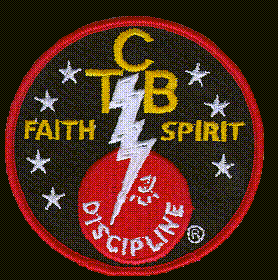
 I usually avoid stickers and things on my guitars, but this a special one – the blue dot is from Tyree Guyton of the Heidelgerg Project in Detroit, and it also reminds me of the National Enquirer’s old Lucky Blue Dot. On the back, Taking Care Of Business - speaks for itself. Charlotte got this for me at Graceland. I love the Enhanced Elvis Concept of not just TCB, but TCB In A Flash!


 Posts
Posts