feb 2009 setup (flash)
Originally uploaded by simonm1965

Wednesday, February 18, 2009
Windmill gig, 16 Feb 2009
feb 2009 setup (flash)
Originally uploaded by simonm1965

Monday, February 2, 2009
Den outing (no 2) - The Stratford Hoard
Eight of my guitars and nearly my entire output of diy pedals are in an exhibition at Stratford Underground station (near the entrance to the DLR platforms) for the next couple of months, curated by Alan Kane. The exhibition showcases the collections of local people, and this is the third phase - my stuff and a ton of Beatles memorabilia. The previous phase had wind-up toys, black baby dolls, lots of different kinds of adhesive tape and packets of sugar, and 8 copies of Michael Jackson's 'Bad' LP.
Here I am on the day they were installed, along with a couple more pics I took at the weekend.


 I'll probably upload some more photos to the set on my Flickr page http://www.flickr.com/photos/30379212@N03/sets/72157613275768898/
also: Transport For London blurb, not up-to-date
http://www.tfl.gov.uk/tfl/corporate/projectsandschemes/artmusicdesign/pfa/artists/alan-kane.asp
I'll probably upload some more photos to the set on my Flickr page http://www.flickr.com/photos/30379212@N03/sets/72157613275768898/
also: Transport For London blurb, not up-to-date
http://www.tfl.gov.uk/tfl/corporate/projectsandschemes/artmusicdesign/pfa/artists/alan-kane.asp
Monday, November 3, 2008
Den outing (no 1) - Tokyo
I did some research in advance, wanting to find older used guitars rather than shiny new ones or high end vintage guitars, so originally planned to avoid the big Ochanomizu guitar strip in favour of smaller shops elsewhere, but after wasting one afternoon looking for pawn shops in the suburbs I didn't have much time left, so I decided to go look there anyway, as it was close to where we were staying. It was quite dizzying, see hundreds of guitars everywhere. So many strats, teles and les pauls and copies, and not much else... I was hoping to see ESP, Burny and other Japanese makes, but these were few and far between, and a lot of the stock was aimed at beginners. I didn't go in any of the major vintage Gibson places as I'm not fussed with that stuff. It was interesting to see the prices of the lower end stuff - reasonable looking tele copies for about £55, but any name makes (even Epiphone) were not any cheaper and sometimes more expensive than UK /web prices.
I went into about 10 shops, some 3 or 4 floors, but only one had anything really tempting - these Danelectro DC-59s, in a place called something like Big Boss Guitar Freak Emporium:
 I liked them, but not sure how much. They looked brand new, so I guess they are NOS (new old stock) from the 1998-2003 Korean period, as the new Chinese ones are quite different (and quite horrible). At about £200, it was good deal but not a bargain. I took the photo and looked at it a few times over the next week, and worked out I'd have time to return on the last day and get one if I wanted, and fit it in my luggage if I took the neck off. These guitars are allegedly in the "getting hard to find" bracket if you believe dealers, but really, they are still easily found in a range of colours. I'll get a Danelectro sometime, and probably a 90s one, but this just wasn't my time.
 I liked them, but not sure how much. They looked brand new, so I guess they are NOS (new old stock) from the 1998-2003 Korean period, as the new Chinese ones are quite different (and quite horrible). At about £200, it was good deal but not a bargain. I took the photo and looked at it a few times over the next week, and worked out I'd have time to return on the last day and get one if I wanted, and fit it in my luggage if I took the neck off. These guitars are allegedly in the "getting hard to find" bracket if you believe dealers, but really, they are still easily found in a range of colours. I'll get a Danelectro sometime, and probably a 90s one, but this just wasn't my time.
Monday, October 6, 2008
Burns Sonic guitar, 1960 ("The Aristone")
One of my modest insights into the world of Ebay is that it's only good at finding things that are correctly identified. It's like cataloguing; one the places where parts of my job extend into my real life. If someone is selling an original Fuzz Face and they call it that in the main description, lots of people will find it/see it/bid on it. But if it's described as a 'round grey guitar peddle', a lot less people will see it. This was how I got the Silvertone/Valco - interest in Supro-type guitars was at a generally lower level than now, and someone checking a Silvertone listing would probably be looking for a Danelectro, and pass on it - I recognised it as a Valco and got it cheap. Look for the vague descriptions, and there are bargains if you don't mind wading through the crap. I got the Burns the same way.
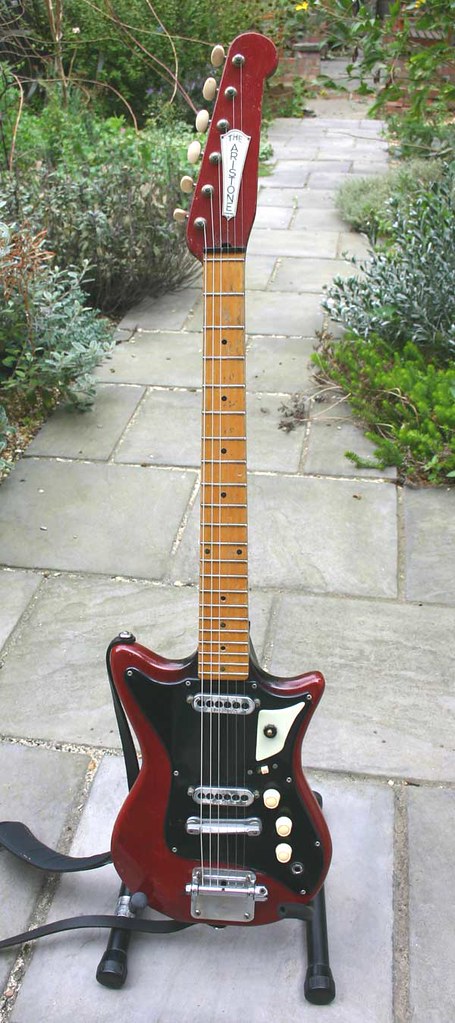
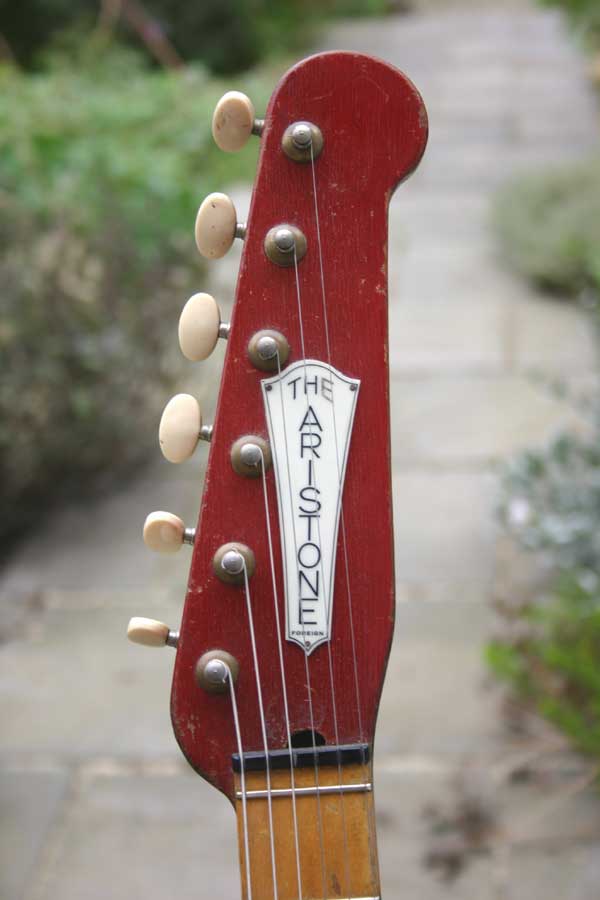 People with an interest in guitars of the early '60s would recognise it as a Burns, but the name on the headstock is "The Aristone", so that was the main Ebay description term. Deal! Aristone were a London company who had been making banjos and ukeleles and archtop acoustic guitars since the 1930s. I've seen one other electric guitar with the same headstock logo, a late 50s semi-acoustic, on sale for a huge sum at Andy's Guitar Workshop in the year they went into liquidation. How Aristone were related to Jim Burns is a mystery, but there's no sign of any other markings, and in every other respect it's a straight-up 1960 Burns Sonic - complete with maple fretboard, white plastic knobs, army surplus 3-way switch and first-stab trem system. My only guess is that if you're starting out trying to sell guitars and nobody knows your name, you might strike a deal to use a bigger name, even if they are best known for banjos. A lot of companies were testing the water of the future beat tidal wave, and Aristone must have been one of them. Whatever the arrangement was, it didn't last. The only other clue is that the word 'foreign' appears at the bottom of the logo - maybe it was an export model.
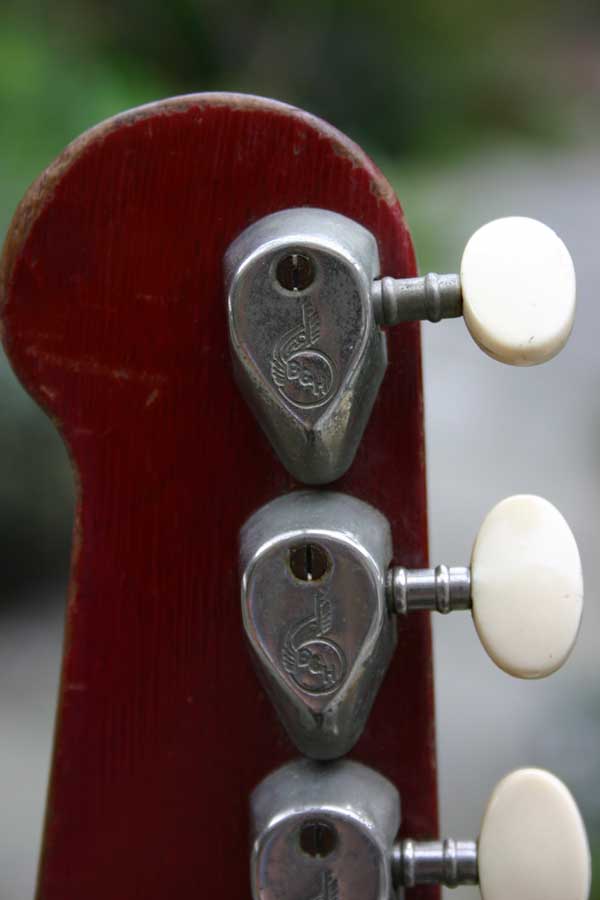
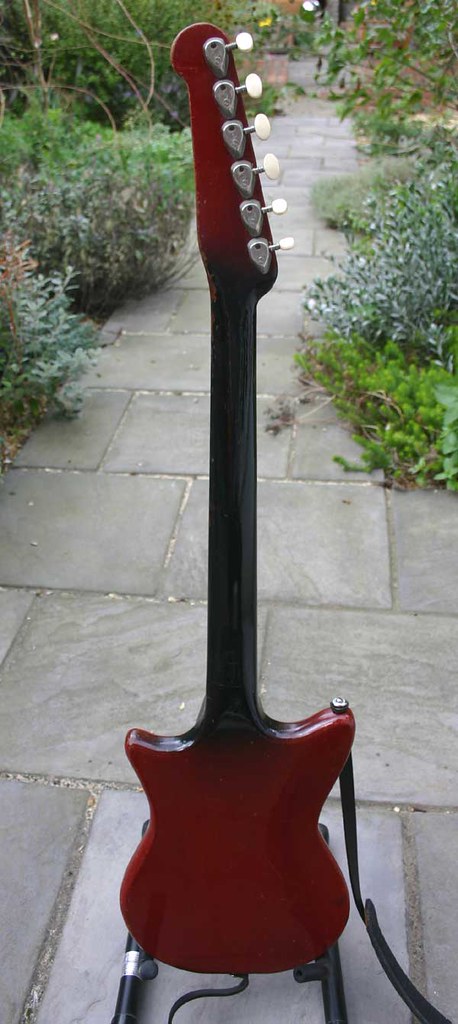 The tuner covers reveal another unusual detail. Guitar nerds will recognise these as Van Gent tuners from the Netherlands, but they are also stamped with the logo of their British distributors, Boosey & Hawkes. I've seen these on some 1950s Grimshaw guitars online, but mostly they are plain.
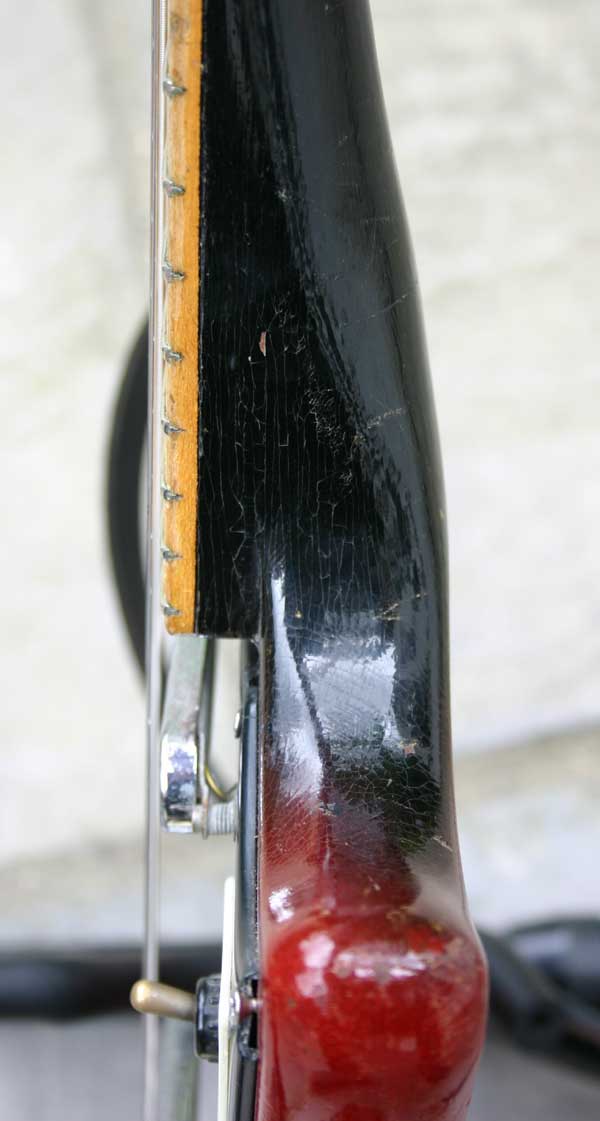
 It's a funny looking thing, badly designed in some ways and brilliant in others. The major problem is the weight of the neck/body joint versus the tiny, admittedly kind of silly-looking body. I had a friend in a band in the grungeful early 90s. He was a very small person and my first thought seeing him playing it was that he must have chosen it to match his stature. I was plain wrong (and probably size-ist), but with this design, how could it be anything other than neck-heavy? This photo also shows up the brittle hollow scratchplate and military grade switch.
 You see some examples with the strap button moved to the lower bout, to move the centre of gravity, but this one has stayed as Mr Burns (tee hee) intended. Balance problems come into perspective when you plug it in - theses are really great pickups, maybe even better than the Valco single coils I love, so why not just sit down if its a problem? They really bite - a very punky spiky beat sound, but with a smoother mid-range and a good growl in the bass. Yay! This the best guitar for fuzz ever.
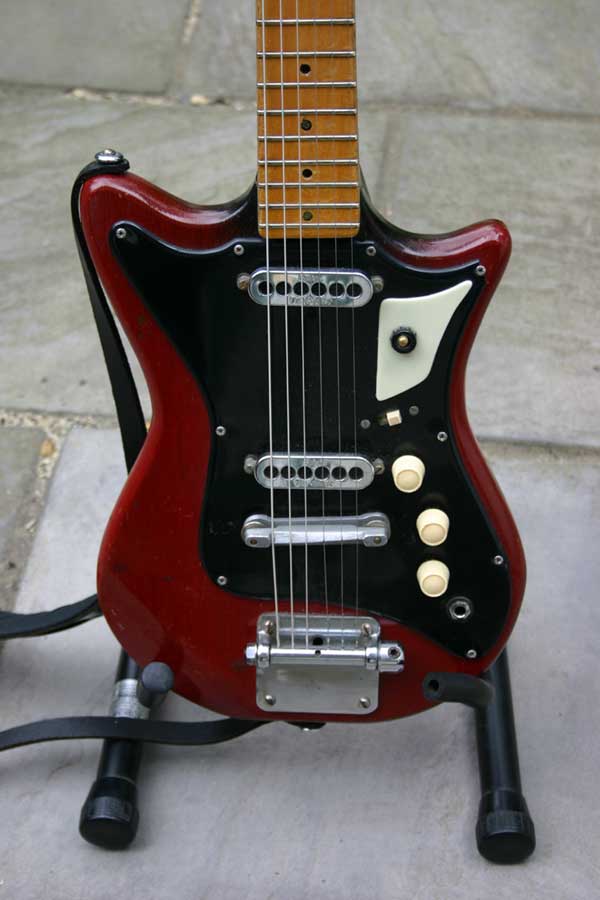 I mentioned the trem system above and you might be thinking 'what trem system?' I took the 'pat. pending' arm off and disabled it to get the action a bit lower, but the pieces are all safe. It didn't work too well in the first place. I also reversed the polarity of the bridge pickup, for more usable sounds. Originally the pickups were out of phase, which made for a strange hollow sound in the middle position that I didn't like. I changed it, but to me it's an improvement. It's been through the wars a bit, so I don't mind making a few positive alterations. To me it's still a working instrument.
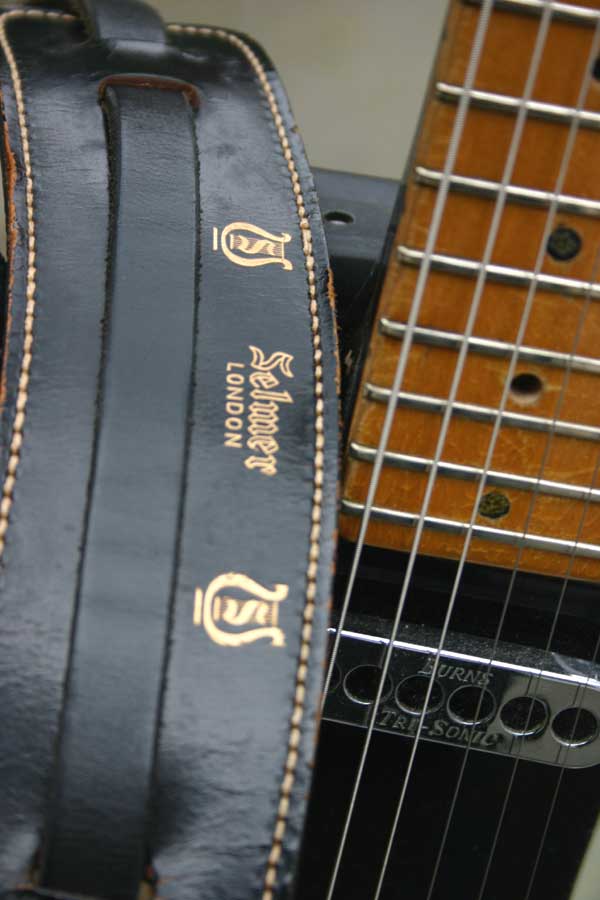 One last thing I should mention is the Selmer strap. This was another ebay find - it didn't come with the guitar, but it's a good match. American collectors call this kind of thing 'case candy'. I could never use that expression, but I don't have the case either.
Sunday, October 5, 2008
Tim Escobedo's Uglyface - a modern classic!
So mainly I like old stuff, but one reason I got into DIY was to discover new sounds. The Uglyface is one of THE classic DIY pedals, designed by an unassuming and generous experimenter, Tim Escobedo. I've built four of his pedal designs, and an ambitious double synthstick built into a guitar (more on this later). I think he came up with it in 2003. A lot of people on DIY Stompboxes were raving about it, so I built mine in 2006. By this time my Dymo tape aesthetic had reached the mature stage, although I probably should have the knobs away from the footswitch.
 In the DIY effects pedal world, there are clones or rare pedals, and there are home projects that become retail Product, and there are pedals that exist only in the pure DIY realm, because they are too weird or horrible-in-a-good way to have mainstream commercial potential, like the Uglyface. Guitarists are conservative as a group (= market). Tradition weighs heavy on their shoulders, and their music is boring. Most of them don't want a pedal that makes their guitar sound like a raygun. I didn't record this clip (Tim did), but it gives you a good idea of what this thing does. Here's another , from homewrecker/runoffgroove - if this doesn't get your attention, then we can't be friends.
 I built it from scratch on plain board with holes, called perfboard, or just perf. This is one of several building methods, and it's probably my least favourite. I don't use it much, but there was (and is) a perf layout of the Uglyface at homewrecker.com. It was one of my first builds beyond the basic fuzz circuits and I didn't really know what I was doing exactly at the time, but I put it together paint-by-numbers style. it took a while to get it right, but I got there in the end. The trickiest part for me was the Vactrol, which adds the envelope follower wah-type sound. I colour coded the wires carefully and made notes, so I wouldn't get too mixed up, and left myself plenty of space.
 So what is it? The clips should tell you all you need to know, but if I had to describe it, I'd say it's kind of like a fuzz, but instead of just taking the wave form from your guitar and amplifying/clipping it to make a square wave (like most fuzz/distortion boxes), the Uglyface takes your signal in on one side, but what comes out of the other side is a whole new signal that tracks the changes in a fuzzed out version of the input signal, but can't follow it exactly, or reproduce its complexity, so what you hear is a big wall of glitchy, synthy guitar noise. I love it. The basic envelope follower makes it even less guitar-like. Certain settings will get you the Star Wars thing going.
There are a couple of ther DIY circuits that apparently have some similarity to this floating around - John Hollis' Crash Sync /Auto Crash and the 4ms Noise Swash, but this is the simplest to build, and best documented. There have been stripboard layouts and a modification or two in the last couple of years. Tim Escobedo rules. I can't help forming mental images of people I've never seen; I imagine Tim has short-ish dark hair and a full but closely cropped beard, a bit like David Fair from Half Japanese perhaps.
Tuesday, September 2, 2008
Epiphone '57 Reissue Les Paul Junior, 2007
I haven't been adding new posts in the last couple of weeks because I've been playing my new guitar instead. I've sold a couple this year and was hoping to snag a single (bridge) pickup Valco, but even the 3/4 size Supers and Tosca brand ones are out of my price range now, plus a lot of US sellers are refusing to send stuff abroad these days because of changes with Paypal seller protection...
So I decided to go for one of these Les Paul Juniors as a reasonable substitute - solid mahogany neck and body, rosewood fretboard, Grover tuners, and a lot cheaper than the '59 Gibson Melody Maker RI that I tried and didn't like last year. These were produced as a "limited edition" of the Epiphone Custom Shop - if you equate Epiphone with crap this might sound like a contradiction in terms, but I thought long and hard about this, read all the reviews and forum posts before taking the plunge. It's a basic instrument, but well made and finished I think. If I didn't like it I could sell it on easily.
From what I can gather from the serial numbers of various examples found online, they were made in two batches in Feb-March 2006, and a longer period in spring-summer 2007, at the Daewon factory in Dalian, Northwest China - there's a video of the place in 2005 here that gives some idea of the environment. I think the first batch were are all Vintage Sunburst, which looks cheap to me, I got an approximately 'TV Yellow' one instead, made in March 2007 - most of the second batch seem to be this colour. Of course it isn't "real" TV Yellow, and it's thick polyurethane, not thin nitrocellulose lacquer. It's very shiny and new looking, and it's not an exact copy of a 1957 guitar, but that's what Gibson's VOS ('Vintage Original Spec') series are for if you have a spare £1,300 to spend.
 It was off ebay from a young guy, but basically brand new, with all stickers etc and protective plastic stuff intact. The yellow ones aren't available new anywhere anymore, but some German suppliers still have the sunburst. Some people have a problem with them being made in China, like it's automatically suspect, but they've been making stringed instruments there for hundreds of years, so I don't think it's an issue per se. I feel slightly bad about supporting the exploitation of Chinese workers - it's cheap because labour is cheap - but that's international capitalism, right? I didn't buy it new, but still.
All my other electric guitars are 40-50 years old, so the newness was more of an issue. It felt big and heavier than I like, almost 8lbs. Some of the fret ends were a bit sharp, but I sorted those out. Frets are chunky, but ok. The neck itself is apparently thicker than a '60s neck, but not a true '50s thickness - I would have liked it thicker but it feels fine really. The fretboard is dense-grained and dark, and felt very dry at first, not like old rosewood at all (surprise!) I dabbbed on some lemon oil and rubbed my greasy fingers into it for half an hour to simulate some kind of preliminary wear. I also sanded along the edge of the fretboard so it wouldn't be so sharp, and dulled down the finish on the back of the neck with 00 steel wool, so it wouldn't be so sticky. These things all helped a lot with the playing 'feel'.
I made some other changes too - what can I say? I'm a tinkerer. The tuners were perfectly good, but I changed them for some nickel plated Grovers I had; I cut the nut slots down by a bit and rounded off the sharp edges around the nut so my hands don't catch on them; I swapped the wrong-looking chrome wraparound compensated bridge for a repro '50s uncompensated bridge/tail, in nickel, naturally. I'm even going to change the strap buttons for nickel ones. I like it! I tightened the truss rod a bit as it was totally loose, and improved the action (though it was ok as it was). I was really willing to give the P100 a go, because I don't have any other guitars with humbuckers and I didn't want to be swayed by the fact that everyone else has replaced it, but after various experiments I decided I'd swap that out too, for a GFS P90 I had in a kind of frankenstein Supro neck Junior I flung together earlier this year (the neck didn't really work with that body...). The consensus on GFS pickups is they're good for the money, and better than the stock Epiphones, but not as good as the £100+ boutique hand-wound ones (surprise no.2) With the pole pieces slightly down on the bass side, and screwed right down to the top, it does sound pretty much like a brighter dirtier Supro pickup. I was surprised to see the treble bleed (tone) capacitor was was a whopping 0.068uF - I changed it for a '50s 0.05 WIMA ceramic I had, but I might replace it with a smaller value in time. Tinker tinker tinker.
The verdict so far is - yes, I like it and it's not going straight back to ebay, but I would still sell it quick if a Supro Belmont came my way cheap. Been playing it every minute I get though, which is a good sign, still need to fine tune the intonation and action.... The acoustic sound is quite twangy, but not as bright as the oldies.
Monday, August 11, 2008
Silvertone Artist, 1958
 This guitar was made by the Valco company of Chicago, for the Sears Roebuck department store house brand Silvertone. Valco also made the National line of guitars and amps, the ‘budget’ Supro line, and a range of brands incuding Oahu and other department store house brands like Airline for Montgomery Ward. It has some similarities to the Supro Rhythm Tone and Belmont models of the late 1950s, with a different headstock, scratchplate/pickguard and tailpiece. The serial number X86897 puts it in early 1958.
 Valco also made a two-pickup solid body guitar for Sears /Silvertone in 1958, much like the first version of the Supro Dual Tone. For some reason the two Valco guitars were given the same model name by Sears - The Artist, with the same distinctive ‘electric cowboy’ headstock logo. On the two pickup version it’s silver, on the single pickup one I have it’s gold. There aren’t many Valco-made Silvertones around, and they don’t seem to have lasted long enough to get into one of their famous mail order catalogues.
 The Artist is a basic guitar, but it feels really great to play. You hear a lot about ‘baseball bat’ necks online, but this is the real thing. I find it very comfortable to play, though my hands aren’t large - the neck is thick. but with a narrower than usual fretboard. Called the ‘Kord King’ neck in Supro catalogues, it has a ‘feather-light modern aircraft metal’ rod running down it but no tension adjustment. It has an ebony (rather than the usual rosewood) fretboard. It is worn in places and has a crack running down it, but the 19 narrow frets are in good shape. Valco moved to a 20 fret neck on most of their guitars in 1958/9. It has white block inlays rather than the dots used on the Belmont most of the lower end Supros, and It’s only really held on with one screw (with a second for neck tilt adjustment) but it feels very solid, with no wiggles. The scale is full Gibson length – 24.75”, though it looks shorter because of where the neck joins the body..
 It’s been played enough to wear away most of the screenprinted Sivertone logo on the cracked and glued ‘deco’ scratchplate, but it’s original owner had the foresight to invest a few extra dollars on a hard case, which I also have, so it’s in good shape overall. The embossed cowboy motif leather strap is a nice touch – it’s an idea borrowed from Gretsch, who Valco built amps and at least one guitar for in this period.
 The finish is a thick black plastic coating that Valco called ‘Glossy Jet No-Mar’. It hasn't bubbled up flaked off anywhere. It matches the 1958 Supro line’s ‘Dashing new color theme of Black, White and Inca Gold’. The tuners are original, but with replaced buttons. I do have a spare rosewood Valco bridge I could use, but I like the brighter sound of the Tune-a-matic, plus it’s the right colour.
The pickup is a single coil, but looks like a humbucker. Some people have assumed this is a deliberate deception, but Valco had their own patent, thanks very much, cited on Seth Lover’s later Humbucker patent documents. For a short time in the late 50s, Valco even took to printing their patent number (2683388) on the outer cover, I think to avoid confusion with the Gibson product. Most people seem to like these big single coil pickups, although there are some dissenters. A lot of people say they're 'great for slide', which is the main cliche used in describing Supro, National and Airline guitars. They are not super-loud, but they distort a little even at low volume through a clean amp, and I like that. They are often compared to P90s, but my limited experience says they have a weaker but more complex sound than a modern (GFS) P90 at least. It’s a little bassy for me in the normal channel, but sounds just right in the bright channel of my Davoli Studio 60 valve amp. Because the neck pocket is deeper than on later Valco solid-bodies, the pickup is set into the top rather than surface mounted.
It’s my favourite guitar to play when I'm just sitting around - smooth low(ish) action and the perfect weight – only 6.5 pounds (just under 3 Kg). The range of amplified sounds from the neck pickup is not huge – but it’s great for fuzz, or with a treble booster! I would love a bridge pickup Belmont or a Rhythm Tone from the same period, but they are getting expensive now.
 I usually avoid stickers and things on my guitars, but this a special one – the blue dot is from Tyree Guyton of the Heidelgerg Project in Detroit, and it also reminds me of the National Enquirer’s old Lucky Blue Dot. On the back, Taking Care Of Business - speaks for itself. Charlotte got this for me at Graceland. I love the Enhanced Elvis Concept of not just TCB, but TCB In A Flash!
Subscribe to:
Posts (Atom)


 Posts